 By Petros Gil
The Clinical Crossroads: Generative AI vs. Patient Confidentiality
Healthcare professionals, clinical researchers, and medical administrators face an unprecedented opportunity: generative AI models can synthesize patient charts, summarize complex longitudinal histories, draft discharge instructions, and translate diagnostic jargon into patient-friendly explanations in seconds.
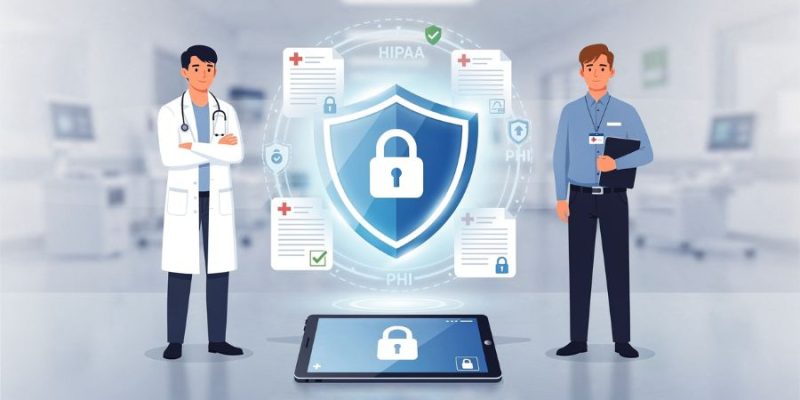
However, healthcare organizations operate under the strict governance of the Health Insurance Portability and Accountability Act (HIPAA), the HITECH Act, and global health data directives. The statutory penalties for unauthorized Protected Health Information (PHI) disclosure are severe:
- Civil monetary penalties exceeding $2,000,000 annually for willful neglect.
- Mandatory public notification of data breaches under the OCR Breach Portal (“Wall of Shame”).
- Irreparable erosion of patient trust and physician liability.
When a clinician, nurse, or medical biller pastes an unredacted patient progress note into an AI chat interface, that act legally constitutes an impermissible PHI disclosure unless a comprehensive Business Associate Agreement (BAA) and technical safeguards govern the transmission.
The 18 HIPAA Safe Harbor Identifiers
To be legally considered de-identified under HIPAA’s Safe Harbor method (45 CFR § 164.514(b)), a medical document must be completely scrubbed of 18 specific direct and indirect identifiers:
| +——————————————————————————-+
| THE 18 HIPAA SAFE HARBOR IDENTIFIERS | +——————————————————————————-+ | 1. Names of patients and relatives | 10. Account numbers | | 2. Geographic data smaller than state | 11. Certificate/license numbers | | 3. All dates directly related to patient | 12. Vehicle identifiers/serial nos | | 4. Telephone numbers | 13. Device identifiers/serial nos | | 5. Fax numbers | 14. Web Universal Resource Locators| | 6. Email addresses | 15. Internet Protocol (IP) addrs | | 7. Social Security Numbers (SSN) | 16. Biometric identifiers | | 8. Medical Record Numbers (MRN) | 17. Full-face photographic images | | 9. Health plan beneficiary numbers | 18. Any unique identifying number | +——————————————————————————-+ |
Failing to remove even one identifier—such as an admission date or a clinical device serial number—means the document remains legally actionable PHI.
Why Cloud-Based Medical Anonymizers Create Compliance Vulnerabilities
Healthcare IT departments frequently attempt to resolve this dilemma by subscribing to cloud-based de-identification APIs. However, this architecture introduces substantial compliance overhead:
- Third-Party BAA Dependency: Every intermediary cloud service that handles raw clinical text must execute a signed BAA, maintain SOC 2 Type II attestation, and undergo annual third-party audits.
- Breach Amplification Risk: Aggregating thousands of patient records on an external cloud server creates an attractive target for ransomware syndicates targeting the healthcare sector.
- Network Latency in Point-of-Care Settings: Clinical staff cannot tolerate 2-to-5 second round-trip API delays when analyzing real-time emergency room notes or patient triage logs.
To overcome these structural limitations, leading medical institutions are deploying a local, zero-server HIPAA-compliant AI scrubber that runs entirely within the local browser memory on the clinic’s existing workstations.
Preserving Clinical Context: The Power of Semantic Token Replacement
Standard redaction tools that replace patient data with generic [REDACTED] blocks destroy the syntactic and chronological coherence of clinical narratives. When an AI receives a note where dates, dosages, and lab values are obliterated, it cannot accurately calculate treatment timelines or evaluate disease progression.
Modern client-side sanitizers solve this by applying Deterministic Semantic Pseudonymization:
| [RAW CLINICAL NOTE – UNPROTECTED]
“Patient Sarah Jenkins (DOB: 14/05/1982, MRN: 9482103) presented to Memorial Hospital on 12/03/2026 with acute chest pain. Contact primary care physician Dr. Robert Vance at (555) 382-9104.”
↓ (In-Memory Client-Side Engine – 0 Bytes Sent)
[SANITIZED CLINICAL NOTE – 100% HIPAA DE-IDENTIFIED] “Patient {{PATIENT_NAME_1}} (DOB: {{DATE_OF_BIRTH_1}}, MRN: {{MRN_1}}) presented to {{HOSPITAL_1}} on {{DATE_1}} with acute chest pain. Contact primary care physician {{PHYSICIAN_1}} at {{PHONE_NUMBER_1}}.” |
When clinicians de-identify clinical notes for AI, the generative AI model receives complete context:
- It recognizes that {{PATIENT_NAME_1}} visited {{HOSPITAL_1}} on {{DATE_1}}.
- It analyzes symptom correlations, medication interactions, and lab results without knowing the patient’s true identity.
- When the AI generates a diagnostic summary or treatment plan, the local application automatically reverse-maps the synthetic placeholders back to the original patient details locally on the doctor’s workstation.
Medical Workflows: Where Client-Side Sanitization is Mandatory
Clinical teams should routinely sanitize medical records across several high-volume administrative and diagnostic scenarios:
- Complex Diagnostic Case Summarization
Physicians handling complex multi-system disorders can paste extensive history and physical (H&P) examination notes into LLMs to generate differential diagnosis considerations and cross-reference rare disease literature.
- Medical Billing and Denial Appeals
Billing specialists frequently process complex insurance claim denials. Scrubbing the patient’s MRN, policy number, and service dates locally allows AI tools to draft compelling, legally grounded appeal letters against insurer denial codes without exposing PHI.
- Patient Education and Discharge Materials
Converting dense clinical prose into clear, 6th-grade reading level discharge instructions helps prevent hospital readmissions. Local de-identification enables nurses to utilize AI for rapid translation into multiple languages while remaining fully compliant with patient privacy regulations.
The Verifiable Compliance Standard: Cryptographic Audit Proofs
For Hospital Compliance Officers and HIPAA Privacy Officers, policy alone is insufficient—enforcement must be empirically verifiable.
Modern client-side sanitizers provide automated Audit Receipts:
- Every sanitization session generates a local cryptographic SHA-256 fingerprint of the scrubbed payload.
- The receipt records the total count of scrubbed identifiers (e.g., 4 Names, 2 MRNs, 3 Dates neutralized).
- Crucially, network inspection proves that 0 bytes of plaintext clinical text were transmitted over public networks.
Conclusion
Generative AI holds enormous promise for alleviating physician burnout and improving clinical decision support. By anchoring hospital AI workflows to zero-trust, client-side data de-identification, healthcare leaders ensure patient privacy is uncompromisingly protected while unlocking the full power of medical AI.